





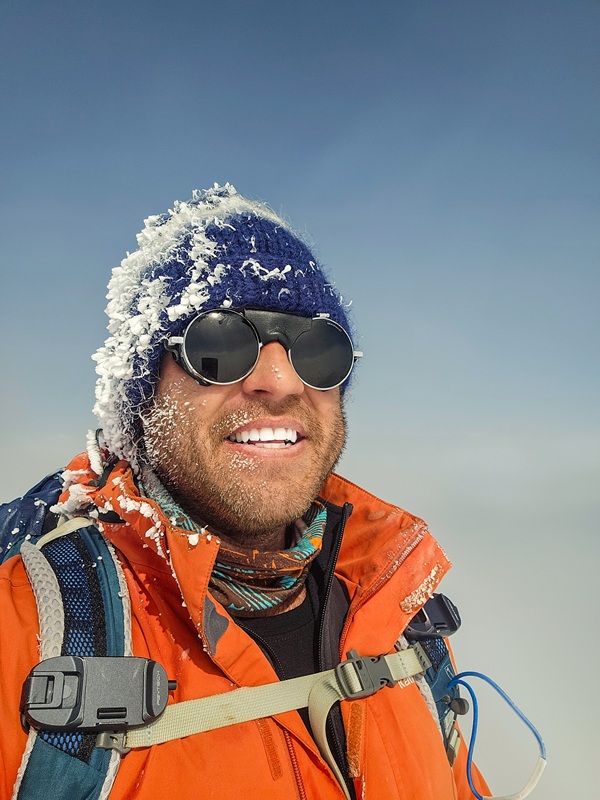
When Marcus Arnold steps onto the frozen ocean off Greenland’s remote east coast later this year, he will be completely alone.
No support crew. No easy escape. No margin for error.
For 30 days, the Fulton Hogan environmental scientist will haul a 90-kilogram sled on cross-country skis around Milne Land, the third-largest island in Greenland, traversing roughly 400 kilometres of frozen ocean in temperatures that can plunge below minus 35 degrees. It is a world-first solo winter circumnavigation, and a challenge that few would even contemplate.
But for Marcus, this expedition is about far more than physical endurance or exploration. It is a deeply personal journey, undertaken to shine a light on mental health in the construction industry and to support the work of Mates in Construction.
From summer seas to winter ice
Marcus knows Milne Land well. Two years ago, he sailed the same route during the Arctic summer, navigating between towering glaciers and sheer rock faces that rise dramatically from the sea.
“While I was there, I thought it would be a really cool thing to do in winter,” he says, with a characteristic understatement. “When it’s minus 35 degrees and crawling with polar bears.”
That seed grew into a two-year planning effort, culminating in an expedition that will see Marcus travel entirely across the frozen ocean. While the terrain is relatively flat, the risks are anything but. Sea ice shifts and cracks. Open leads can appear without warning. Icebergs, some rising more than 100 metres above the surface, can fracture suddenly, sending shockwaves through the ice.
“There’s no reprieve from the cold,” Marcus explains. “I don’t have a warm car or a lodge to go back to. I’ve got my tent, and it’ll be minus 30 degrees inside that as well.”
Every item of equipment must work flawlessly. If a stove fails, Marcus cannot melt snow for water. If clothing fails, there is no backup. His daily energy intake will be around 5,000 calories, burned through long days of skiing, often 10 hours or more, towing his sled across the ice.
A journey shaped by lived experience
The physical challenge is immense, but it is the mental challenge that lies at the heart of this expedition.
A few years ago, Marcus went through a prolonged and difficult period with his mental health. With the support of family, professionals and organisations like Mates in Construction, he worked his way through it, emerging with a deep appreciation for the power of connection, openness and shared experience.
“What I’ll be going through in Greenland will be really similar to a mental health journey,” he says. “Complete isolation. Darkness. Cold. That’s what it feels like when you’re in a really bad place mentally.”
Partnering the expedition with Mates in Construction was a natural decision.
“I didn’t want this to just be a trip I wanted to do,” Marcus says. “I wanted it to be something bigger than that, something that might help someone else.”
Changing the conversation in construction
Marcus began his career in construction in 2016, when mental health was rarely discussed openly on sites.
“The change over the past 10 years has been enormous,” he says. “There’s still stigma, but we’re far more open and supportive than we used to be.”
He points to the growing willingness of senior leaders to share their own experiences as a powerful signal to the industry.
“When someone very senior talks openly about their mental health journey, that’s huge. You wouldn’t have seen that a decade ago.”
It is also why Marcus believes lived stories matter more than statistics alone.
“When you hear a real story from someone you respect, it lands differently,” he says. “You connect with it. You see yourself in it.”
Training for isolation
Preparation for the expedition has been as much mental as physical.
Before setting foot on the Greenland ice, Marcus will spend several weeks in Norway learning cross-country skiing, a discipline he has never done before, followed by a two-week training expedition on a high-altitude ice cap under the guidance of an experienced polar expedition leader.
Back in Australia, his training has included deliberately monotonous sessions: dragging a tyre along the beach for hours at a time, fasting before long workouts, and working with his psychologist to break long, difficult days into manageable segments.
“It’s about learning how to stay steady when you’re cold, hungry and bored,” he says. “Because that’s when things get hard mentally.”
Life on the ice
A ‘good’ day in Greenland will be a boring one.
Marcus has planned daily waypoints of around 17 kilometres, knowing that Arctic weather will ultimately dictate progress. Some days may require covering far greater distances; others may be spent entirely in a tent, waiting out storms that can last a week.
“It’s incredibly routine,” he says. “Wake up, pack the tent, ski for hours, set up camp, eat, sleep, then do it all again.”
In that routine, Marcus sees a powerful parallel with recovery and resilience.
“Sometimes success is just putting one foot in front of the other.”
Supported by industry
Marcus is quick to acknowledge the support that has made the expedition possible, particularly from Fulton Hogan, which has backed his leave and his cause.
“Ten years ago, a contractor might have said, ‘Give us a call when you’re back, if there’s a job,’” he says. “The support I’ve had shows how much the industry has changed.”
He also credits his family and the broader construction community for standing behind him.
“Knowing you’re not alone makes all the difference.”
Following the journey
Throughout the expedition, Marcus will send daily updates via satellite, including photos, voice notes and location data. His sister will manage social media updates, allowing people to follow his progress across the ice in near real‑time.
The expedition will raise awareness and funds for Mates in Construction, with information, live tracking and donation links available via Marcus’s website.
For Marcus, success is not measured in kilometres or records.
“If one person hears this story and realises there is a way through a really dark time, that’s success,” he says. “If it starts a conversation that wouldn’t otherwise have happened, that matters.”
As he prepares to step into the Arctic winter, Marcus carries that purpose with him, one ski stride at a time.